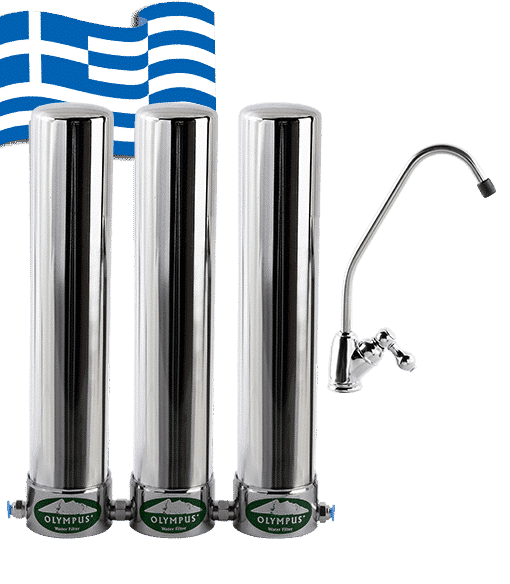
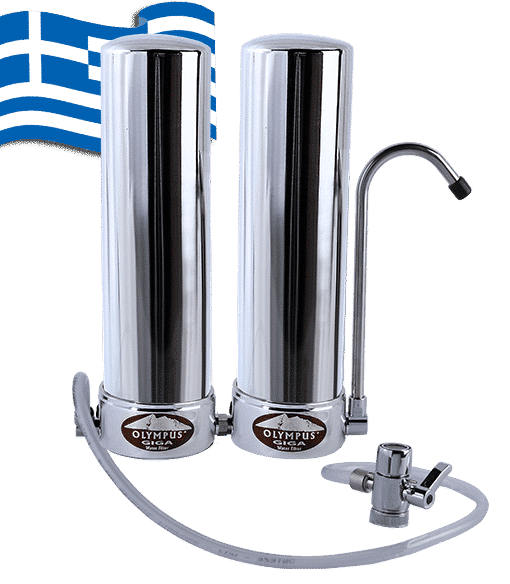
Olympus+ Ceramic Water Filter 
The Antimicrobial Water Filter, which destroys microbes inside the device and on the surface of the ceramic filter in 2 hours – Installation under the sink
Installation and maintenance instructions – Installation under the sink
Device description – Package contents

Device description – Package contents
1. Antimicrobial copper alloy base
2. Stainless steel metal cover (water chamber)
3. Water inlet tap (Screwed into the base (1) with Teflon tape on the thread)
4. Metal coupling clamp. (First pass it through the hoses (5 and 11) and screw it tightly to the inlet and outlet nozzles (3 and 9) after having previously installed the hoses (5 and 11)
5. Plastic hose 1/4″ (connects to nozzles 3 and 9 respectively)
6. Metal connector clamp for flexible hose (5) with tap (7) (first pass the clamp through the hose (5) and screw)
7. 1/4″ water supply tap to the filter (connects to the cold water) put Teflon or hemp on the thread and connect it to the nipple (8)
8. Nipple (T-distributor) for supplying water to the kitchen tap and to the filter. (Put Teflon tape on the thread and connect it to the power supply).
9. Outlet tap for filtered water to the faucet (Screwed into the base (1) with Teflon tape)
10. Metal connector retainer
11. Plastic hose 1/4''
12. Metal nozzle for connecting to the tap (pass it through the hose (11))
13. Plastic wedge (insert it into the plastic hose (11) for reinforcement)
14. Plastic conical cylinder for sealing (nipple) (pass it through the hose (11))
15. Metal nut for attaching the faucet (screw all the way tightly onto the faucet thread to stabilize the faucet at the bottom of the sink)
16. Serrated metal washer (grower) for securing (placed under the plastic washer (17))
17. Plastic support washer (placed under the sink)
18. Rubber sealing washer (placed under the sink)
19. Rubber sealing washer (placed above the sink)
20. Oval metal crane support base (remove blue nylon protective cover)
21.Stainless steel swivel faucet.
22. Ceramic filter – replacement filter cartridge (screws into the center of the metal base of the device)
23. Large rubber sealing washer between the metal base (1) and the metal cover (2)
24. Antimicrobial Copper alloy disc (inserted), for killing microbes
Operating parameters
-Maximum working pressure: 7 BAR
-Operating temperature: 38about C(100about F)
-Minimum operating pressure: 1 BAR (Reduced flow rate) - Recommended operating pressure: 3 – 7 BAR
-Minimum operating temperature 5°C (41about F).
– Recommended filter flow rate for perfect filtration 1.5 – 2.5 liters/minute at 3 – 3.5 BAR mains pressure
ORDER OF INSTALLING THE SPARE CASSETTES FOR THE DOUBLE OR TRIPLE FILTER
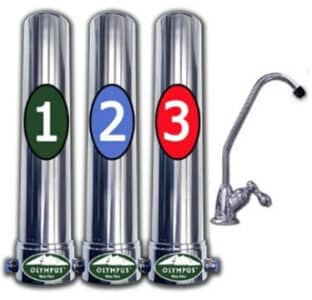


IMPORTANT: Place the inlet (3) and outlet (9) taps in the base or bases and wrap Teflon tape (not included) on their threads to avoid possible water leaks.
1. INSTALLATION: (The responsibility for the correct and safe installation of the filter lies with the customer)
The filter should be placed upright under the sink, close to the water supply, and its tap should be placed in the desired location on the sink. Cut the 2-meter hose included in the package into 2 parts of such a size that you can pull the appliance out of the cabinet when changing the filter. (If the hose is cut crookedly, you will have a leak)
2. WARNING
Make sure the water inlet to the filter follows the direction of the arrow, at the bottom of the metal base (1) of the appliance (see figure 1). AIf connected backwards, the ceramic cartridge will become clogged or broken..
PLACEMENT OF THE HANDLE ON THE SINK
– Пробийте с подходяща бормашина отвор с диаметър 11mm (милиметра) в мивката на желаното място за кранчето (21) (first drill with a 6 millimeter drill bit).
– Before placing the faucet on the sink, first pass the nickel metal base (20) through its pipe, after peeling off the nylon protective coating, and pass the larger black rubber sealing washer (19) under it.
– Поставете кранчето в отвора, който сте пробили върху мивката, а на частта от крана, която се намира в долната част на мивката, сложете по реда, както са показани на чертежа, принадлежностите (18), (17), (16) и завийте металната гайка (15) докрай здраво, за да уплътни и да се закрепи кранчето върху плота.
– Прекарайте металния фиксатор (10) на единия край на маркуча (11). Свържете маркуча (11) към изходния накрайник (9) и завийте добре металния фиксатор (10).
– На другия край на маркуча (11) прекарайте първо металния накрайник (12), след това овалното пластмасово цилиндърче (нипелче) (14) и след това сложете вътре в пластмасовия маркуч пластмасовия клин (13), за да стабилизира нипелчето (14) на мястото му. Завийте добре металния накрайник (12) на резбата на опашката на кранчето.
– Завийте касетата (22) в базата на филтъра (1) (loosely), without tightening it too much so that it doesn't break its plastic thread or ceramic filter, or the water flow rate may decrease.
– Завийте добре металния капак на уреда (2) към базата му. Сега отворете крана и from the filter tap, the first time, some black water may come out from rinsing the activated carbon.
3. ATTENTION: Първия път и всеки път, когато сменяте касетата, оставете водата да тече 10 минути. Не използвайте филтъра в продължение на 24 часа. След 24-те часа оставете да тече 2-3 минути и филтърът е готов за употреба. Освен това, ако филтърът остане неизползван повече от 3 дни, оставете водата да тече 2-3 минути.
4. ATTENTION: Only cold water should be used through the filter. If you use hot water, the binding and sealing materials on the cartridge will come loose, resulting in sediment, mud, rust, as well as chemical elements in the water, such as chlorine, etc., not being retained by the filter.
5. FILTER (CARTRIDGE) REPLACEMENT
When replacing or cleaning the ceramic cartridge, it is a good idea to make sure that any cuts or wounds on your hands are covered to avoid contact with any germs that may have settled on the outside of the ceramic filter and that the antimicrobial copper in the base has not yet been able to destroy, as it takes about 2 hours to destroy them. Otherwise, follow the same procedure for replacing the cartridge as when you first installed the filter.
To unscrew the metal cover (2), first turn off the water supply to the filter and at the same time open the filter tap (21) on the sink to release the pressure and make it easier to unscrew the metal cover (2).
Interrupt the water supply to the filter when you want:
A) Complete water cut-off to the filter.
B) Cleaning the cassette.
C) Changing the cartridge.
D) When you are away from home for days.
6. MAINTENANCE – CLEANING THE CERAMIC CASSETTE
Every 3-4 months or whenever the water flow rate decreases noticeably from the appliance tap (which means that the ceramic filter cartridge has become "clogged" with sediment, rust, mud, silt, limescale, etc.), remove it from the appliance and rinse it with cold water under the tap (without detergents), scrub it well over the entire surface with the wire part of the dish sponge, or with a harder wire material, or even with sandpaper (number 80) to clean and improve the water flowAfter rinsing it well, put it back in its place.
7. RECOMMENDED FILTER FLOW – TIME TO REPLACE SPARE CARTRIDGES
IMPORTANT: The highest filter efficiency is achieved when the water flow rate through the filter does not exceed 1.5 to 2 liters per minute. The cartridge capacity is for 8,000 liters of water or for 10-12 monthswhichever occurs first. The cartridge life may be reduced in cases of networks loaded with impurities such as mud, rust, silt, soil, limestone, etc., or in periods of drought when the load on the water supply networks is very high (due to low water levels). In these cases, the filter should be cleaned much more often and replaced earlier if, despite cleaning, the water flow rate in the appliance tap is not restored.
But regardless of the number of liters of water that will pass through the filter, you MUST replace the cartridge every 10-12 months at the latest, because from the moment it gets wet, its materials weaken month after month and the water that passes through the filter will pass unfiltered.
8. ANTIMICROBIAL DISC AND BASE MAINTENANCE
On the surfaces of the antimicrobial copper alloy materials, and more specifically inside the base (4) and the disc (6) located therein, a superficial discoloration may occur due to the natural oxidation of the antimicrobial copper, deposits of various materials coming from the water supply networks, such as rust, mud, etc. In these cases, these deposits, which in no way burden the overall operation of the filter, are good, both for aesthetic reasons and for reasons of cleanliness of the filter chamber, be removed in the following way:
a) Clean both surfaces of the antimicrobial disc thoroughly with something harder like a potholder, coarse sandpaper, etc. b) Clean the inside of the antimicrobial base in the same way to remove any deposits that look like rust.
9. METAL APPLIANCE CLEANING PROCEDURE
Wipe the appliance with a soft cloth slightly dampened with lukewarm water. Avoid using bleach or any chemical detergent or bleaching agent, or wire cloths as they will leave marks on the metal surface of the appliance.
10. IMPORTANT! To protect your filter, after any water supply interruption, ALWAYS let your tap run for a while before using the filter.
11. ATTENTION: The OLYMPUS+ water filter is designed for waters that are controlled by Municipal or Local Authorities and are fit for human consumption.
12. ATTENTION TO WATER PRESSURE
If the mains pressure is high, install a pressure reducer before the water filter. But regardless of whether the mains pressure is high or low, it is essential to install a non-return (anti-shock) valve (available at plumbing stores) so that in the event of a sudden increase in mains pressure or a momentary water hammer, the hoses or the filter unit do not break and you flood. When you are away from home for days, you should always close the water supply tap to the filter.
View product instructions in pdf format by clicking here.