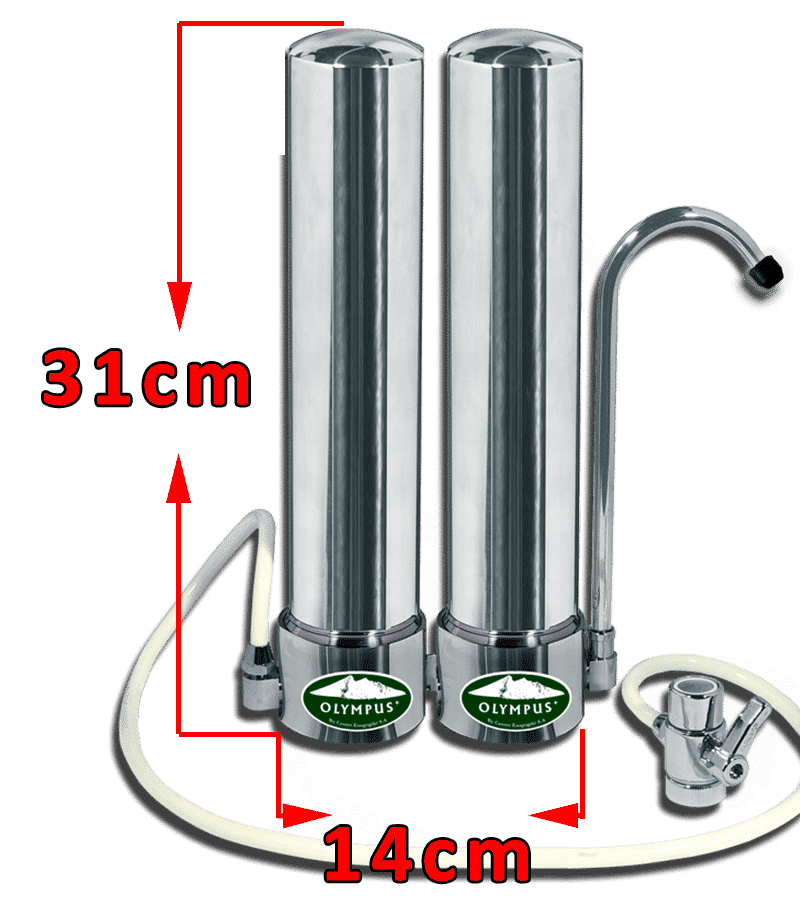
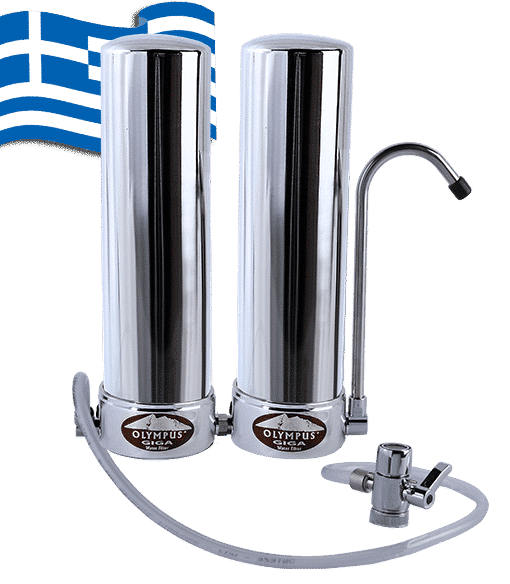
The antimicrobial countertop water filter that destroys microbes inside the appliance and on the surface of the ceramic filter in 2 hours.
Installation and maintenance instructions
Operating parameters
– Maximum operating pressure: 7 BAR
– Работна температура: 38 °C (100 °F)
– Minimum operating pressure: 1 BAR (reduced flow rate)
– Recommended operating pressure: 3 – 7 BAR
– Minimum operating temperature 50C(410F)
– Recommended flow rate of filtered water for perfect filtration 1.5 to 2.5 liters/minute at a network pressure of 3 – 3.5 BAR.
Device description – Package contents
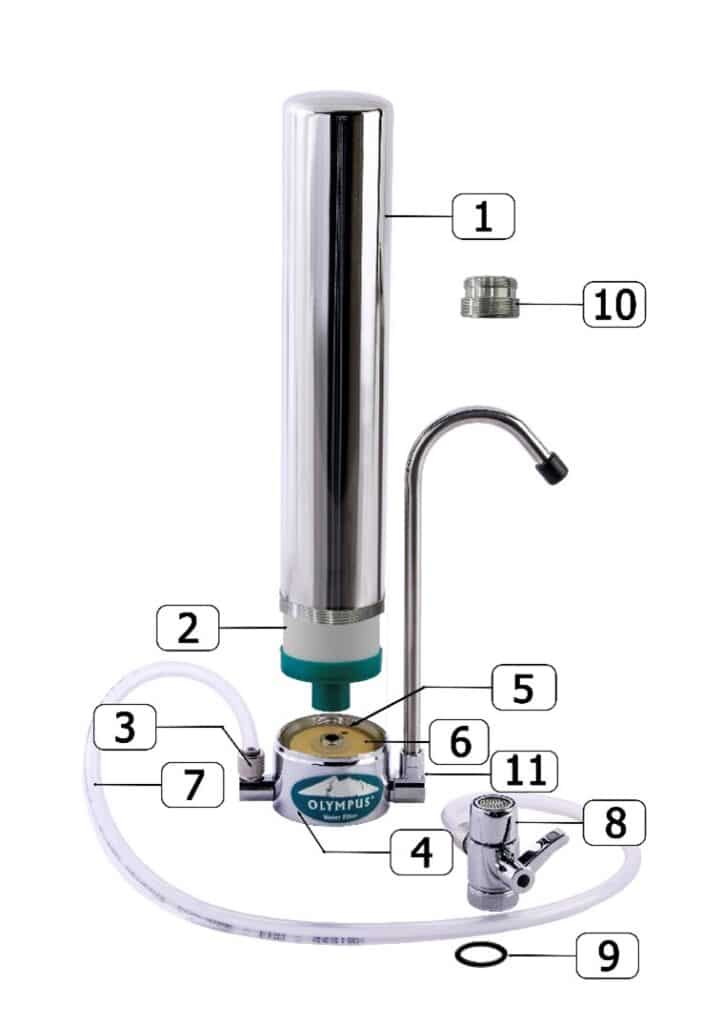
The Olympus+ water filter contains the following parts for assembly:
1. Water chamber (stainless steel lid)
2. Ceramic filter (replacement filter cartridge)
3. Metal angle for water inlet with clamp for attaching the connecting flexible hose
4. Antimicrobial copper alloy metal base with built-in faucet
5. Central sleeve on the metal base for attaching the antimicrobial copper disc and screwing in the filter cartridge (spare)
6. Antimicrobial copper alloy disc (already installed)
7. Flexible hose to connect the appliance to the water supply tap
8. Metal switch (valve) for connecting the filter, with a choice between filtered and unfiltered water
9. Sealing washer between the valve and the tap (must always be installed)
10. Nipple for connecting to a tap with internal thread or to a shower tap
11. Metal angle for water outlet and faucet attachment
1. 1 MINUTE DEVICE INSTALLATION
1) See the picture of the device with the parts numbered 1 to 11.
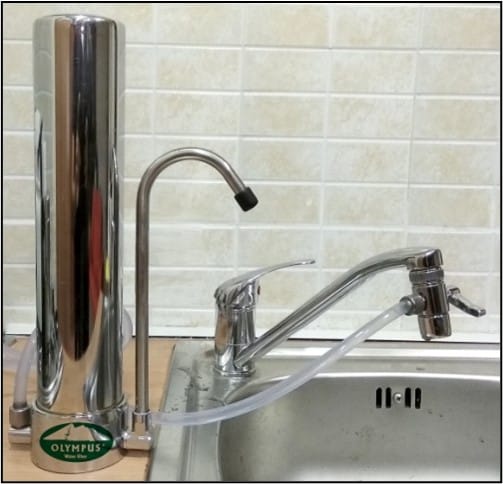
2) Place the appliance on the sink countertop or in an adjacent space.
3) Carefully remove the filter cartridge (spare) located inside the metal cover.
(water chamber) (1) of the appliance.
4) Unwind the plastic wrap that wraps the filter cartridge (2).
5) Turn slightly the filter cartridge (2) clockwise, without tightening it too much, so as not to break its plastic thread or ceramic, or reduce the water flow rate.
6) Screw the metal cover (1) back firmly to the right.
7) Unscrew the strainer from the kitchen faucet to the left and screw it to the right in its place. the valve (switch) (8) (see details in section 2).
8) For filtered water, turn on the tap and turn the switch handle to the horizontal position. (On first use, some black water may come out from rinsing the activated carbon) For unfiltered water, turn the switch to the vertical position.
ATTENTION
The flow rate of the filter tap also depends on the water pressure in the water supply network. At a network pressure of 3 – 3.5 BAR, the filter flow rate will be about 1.5 – 2.5 liters of water/minute. If the network pressure is high, open the tap less to have a lower flow rate and excellent quality of the filtered water.
ORDER OF INSTALLING THE FILTER CASSETTES (SPARE) FOR DOUBLE AND TRIPLE FILTERS
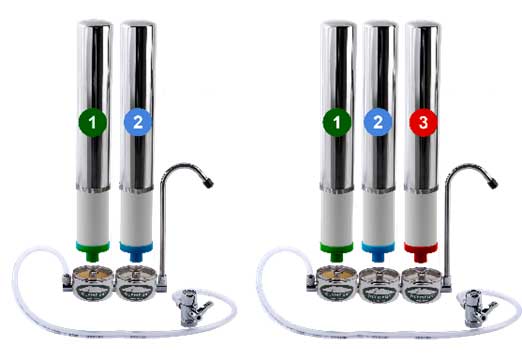
If your device is double or triple, place the filter cartridge with the green thread in position 1, and the cartridges for limestone or nitrates (blue or red thread) on the other bases in any order.
2. CONNECTING THE FILTER TO THE TAP
Unscrew the small filter with the sieve from the tap spout so that you can screw the filter valve (switch) (8) in its place. If the tap thread is external after unscrewing the sieve, screw the supply valve (8) directly in a clockwise direction. Tighten firmly by hand and, as far as possible, avoid using a tool that could damage the valve or strip the thread. If the tap thread is internal, use the nipple (10) for regular taps or shower taps. Screw the wide side of the nipple into the inside of the tap (where you unscrewed the sieve) and tighten it well. Screw the supply valve (8 - filter-unfiltered water switch) onto the thread with a smaller diameter on the nipple to achieve the connection. If your tap does not fall into one of the 2 previous hypotheses, contact our company.
ATTENTION : If the filtered-unfiltered water switch is stiff when switching during first use, apply more force to get it to work.
3. ATTENTION:: The first time and each time you change the filter cartridge, let the water run for 10 minutes. Do not use the filter for 24 hours. After the 24 hours, let it run for 4-5 minutes and the filter is ready for use. Also, if the filter remains unused for more than 3 days, let the water run for 2-3 minutes.
4. ATTENTION:Only cold water should pass through the filter. If you run hot water, the binding and sealing materials of the cartridge will peel off, as a result of which sediment, mud, rust, as well as chemical elements of the water, such as chlorine, etc., will not be retained by the filter.
5. FILTER REPLACEMENT (FILTER CARTRIDGE)
When replacing or cleaning the ceramic cartridge, it is a good idea to make sure that any cuts or wounds on your hands are covered to avoid contact with any germs that may have lingered on the outside of the ceramic filter and that the antimicrobial copper on the base has not yet been able to destroy, as it takes about 2 hours to destroy them.
Otherwise, to replace the cartridge, follow the procedure as for the initial installation of the filter.
6. MAINTENANCE – CLEANING THE CERAMIC CASSETTE
Every 3-4 months or at any time the water flow rate from the appliance tap has noticeably decreased (which means that the ceramic filter cartridge has become "clogged" with sediment, rust, mud, scale, limescale, etc.), remove it from the appliance and under running cold water (without detergents) Scrub it well over the entire surface with the wire side of a dish sponge or a harder wire material, or even sandpaper (number 80) to clean it. and improve the water flow. After rinsing it well, put it back in its place.
7. RECOMMENDED FILTER FLOW – TIME TO REPLACE SPARE PARTS
IMPORTANT: The highest filter efficiency is achieved when the water flow rate from the filter does not exceed 1.5 to 2 liters per minute. The capacity of the filter cartridge is for 8,000 liters of water or for 10-12 monthswhichever occurs first. The cartridge life may be shortened in cases of contaminated networks with impurities such as mud, rust, scale, soil, limestone, etc., or in periods of drought when the load on the water supply networks is very high (due to low water levels). In these cases, the filter should be cleaned much more often and replaced earlier if, despite cleaning, the water flow rate from the appliance tap does not recover.
But regardless of the number of liters of water that will pass through the filter, you MUST replace the filter cartridge every 10-12 months at the latest, because from the moment it gets wet, its materials weaken month after month and the water that passes through the filter will pass unfiltered.
8. MAINTENANCE OF THE ANTIMICROBIAL DISC AND BASE
On the surfaces of the antimicrobial copper alloy materials, and more specifically on the inside of the base (4) and on the disc (6) located therein, a superficial discoloration may occur due to the natural oxidation of the antimicrobial copper and the accumulation of various materials from the water supply networks, such as rust, mud, etc. In these cases, these deposits, which in no way burden the overall operation of the filter, are good, both for aesthetic reasons and for the cleanliness of the filter chamber, be removed as follows:
a) Clean both surfaces of the antimicrobial disc thoroughly with something harder, such as a wire pot scourer, coarse sandpaper, etc.
b) Clean the inside of the antimicrobial base in the same way to remove any deposits that resemble rust.
9. PROCEDURE FOR EXTERNAL CLEANING OF THE METAL APPLIANCE
Wipe the appliance with a soft cloth slightly dampened with lukewarm water. Avoid using bleach or any chemical cleaner or bleaching agent, or cloths with a wire section, as they will leave marks on the metal surface of the appliance.
10. WARNING! Every time you turn off the tap, the filter will continue to release a little water for a few seconds. This is normal because it releases the water pressure that builds up inside the appliance's chamber.
11. IMPORTANT! To protect your filter, after each interruption of the water supply, ALWAYS let the tap run for a while before using the filter.
12. WARNING: The OLYMPUS+ water filter is designed for waters that are controlled by municipal authorities and are fit for human consumption.
View product instructions in pdf format by clicking here.